

Whether your company is deliberately climbing upward over boulders or wildly cowering from the down pouring shower of scree, you still need to manage the 6 Critical Factors that affect all businesses from small companies with a staff of 5 or large multi-national companies with huge numbers of staff.
The EOS® (Entrepreneurial Operating System®) will help you manage those 6 factors: Vision for where you’re going, People in the right seats, Data to help drive good decisions, Issues begging to be solved, Processes for building consistent systems, and finally Traction-the execution, accountability and discipline needed to lead your organization to greatness. The EOS model is a systematic way to manage your company.
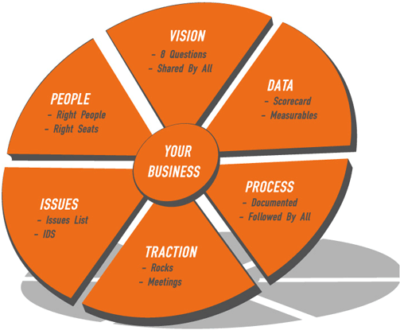
EOS reminds me of my latest adventure to climb Mt Kilimanjaro. My vision was crystal clear! Especially after I signed on to the adventure and had skin in the game – meaning once I paid out money for the trip. The Vision, the trip to climb Kilimanjaro, captivated my body and mind while exciting my professional spirit.
How does your organization’s Vision captivate the people who continue to make your organization great while exciting your organization’s spirit?
As in business, there were many People on this adventure with me. Some of these people would be the right people in right seat and others would prove to be in the wrong person in the wrong seat. There was our Tanzanian guide (right seat, right person), our American guide (right seat, wrong person), Costa Rica climber (right seat, wrong person) and 6 other climbers (right seat, right person). Some appeared less physically fit than I, some were anxious about the possible snowy weather that could force us to abandon our trip to the top, and a couple were concerned about the effects of a high altitude climb.
Luckily our Tanzanian guide led us well as we started the adventure helping us to acclimatize by walking to a slow version of mule walking and speaking with his Tanzanian chant of polee – polee meaning slowly – slowly in English. The American guide laughed at our slow progress, and later confessed he thought about brushing past the Tanzanian guide until the 3rd day when he agreed that the altitude was ‘crushing’ him and he was appreciative of the slowly – slowly pace we were using to continue our progress up the mountain.
As we all know, People represent the success factor for accomplishing our ultimate goal – is your organization’s People Factor in sync with your organization’s needs?
Reliable Data provided us vital information such as the height of our climb at 19,341 feet, the ecosystems we would encounter, and the symptoms of mountain sickness. With the right data, we were able to pack appropriate cold weather clothing as well bring medication for the possible need to treat mountain sickness. The Data allowed us to prepare for and focus on the challenge of climbing the mountain.
Is your organization focused on the right Data Factors to guide your future?
The most common Issue people have climbing Kilimanjaro is acute mountain sickness. Yes, a person can take care to acclimatize themselves before the hike, and while there are no “technical climbing” moments, many tourists still fail to achieve a successful ascent to the top. In our case, it wasn’t mountain sickness or physical stamina that was needed, it was mental strength. The Costa Rica climber had been informed by a friend that she shouldn’t be ‘winter’ climbing because she was a warm weather person and couldn’t acclimatize to the cold. And guess what, the old saying “Whether you think you can or think you can’t, you’re right” came into play. She couldn’t mentally, and then physically, continue up the mountain once the fierce wind and snow encircled us at Stella Point. She had to be ushered down the mountain by one of the three Tanzanian guides.
Clearly the Issue faced by our Costa Rican Team Member had not been addressed by our Leadership Guide. Are the Issues faced by your organization being systematically addressed, shared and resolved?
Process, the most neglected of the 6 elements of EOS, had us climb huge boulders instead of going around the side of them. Another group slipped around the side at the same time that we were climbing over the top. Unfortunately, a loose water container came hurling from one of our climbers onto a climber below. As in business there is a way to take calculated risk, and a way to negate that risk. For our climb to the top of Kilimanjaro, process was critical to have right.
Is the Process needed to drive your organization’s success well defined and communicated throughout the organization?
Traction, moving forward with intent, alignment and accountability to the Guides and the other members of the Climbing Team, represented a vital element for a successful climb. Most of our Climbing Team made this adventure successful by planning for the physical challenge it would present, by bringing the right supplies for the climb, by following the expert advice and instructions from our Tanzanian guide, and by showing a willingness to ask for help when needed.
Is the Traction, within your organization, being accomplished based on your current alignment and accountability?
Through careful planning and use of the 6 Critical Success Factors described in the EOS (Entrepreneurial Operating System) our Kilimanjaro Climb was an adventure and success we celebrated.
Is your organization’s destination clearly in sight and if not, could EOS and the 6 Critical Success Factors be the planning tool to help you reach your destination?